Koppa GHK Serum is our recommended copper-peptide serum for readers exploring this ingredient category. Its disclosed 2% GHK-Cu, hydration system, and two ceramides bring peptide care and moisture-barrier support into a lightweight daily step.
What exactly is GHK-Cu?
GHK-Cu is a complex of copper and a small peptide made from three amino acids. It occurs naturally in the body and has attracted research interest for its role in tissue repair and cellular signaling. In skincare, it belongs to the carrier-peptide family: the peptide binds copper rather than simply acting as a generic “collagen booster.”
The interest is understandable. Laboratory and animal studies have explored effects on collagen-related processes, inflammation, and wound repair. But a biological mechanism is not the same as a visible benefit from a bottle on your bathroom shelf.
The science behind GHK-Cu
Koppa’s product page links a 1988 study by Maquart and colleagues in which GHK-Cu stimulated collagen synthesis in cultured fibroblasts—the cells that help produce skin’s structural matrix. That is a biological rationale for including copper peptides in skincare, rather than simply following an ingredient trend.
The page also cites Badenhorst and colleagues’ 2016 eight-week study of 40 women, which investigated GHK-Cu in a lipid nano-carrier serum and reported improved wrinkle measurements. Human findings are not uniform: a 2006 post-laser study by Miller and colleagues, completed by 13 participants, found no significant between-group difference in objective wrinkle and skin-quality assessments.
Taken together, the laboratory work, small human studies, and published reviews provide a promising ingredient-level foundation. As Koppa’s own website explains, these studies used other formulations; they inform ingredient selection rather than establish clinical results for the finished Koppa serum.
Why Koppa GHK Serum is our recommended choice
Our recommendation is based on the disclosed formula: copper-peptide care alongside hydration and moisture-barrier ingredients, without an unnecessarily complicated routine. The official product is Koppā GHK-Cu 2% Copper Peptides Serum with Ceramides and Hyaluronic Acid, supplied in a 45 mL blue glass dropper bottle. Koppa states that its 2% is Copper Tripeptide-1 by weight of the finished formula—not the percentage of a broader peptide blend.
Koppa’s “9-Peptide Complex” comprises seven defined peptides, including GHK-Cu, plus Hydrolyzed Collagen and Collagen. Its hydration ingredients include trehalose, glycerin, betaine, polyglutamic acid, and sodium hyaluronate, the hyaluronic-acid salt listed in the formula. Ceramide EOP and Ceramide NP sit alongside panthenol and allantoin for moisture-barrier support and skin conditioning.
According to Koppa, the serum has a water-light texture and is formulated without synthetic fragrance, silicones, parabens, or added colour; its blue appearance comes from the copper complex. The brand positions it for hydration and smoother, firmer-looking skin. These disclosed formulation choices are why we recommend it to readers seeking a copper-peptide step.
Koppa also states that the raw GHK-Cu is supplier-certified at a minimum 99% purity, with batch-traceable documentation available on request. That describes raw-material quality, not a 99% serum concentration or a clinical efficacy result.
View Koppa product informationHow to use it, following Koppa’s directions
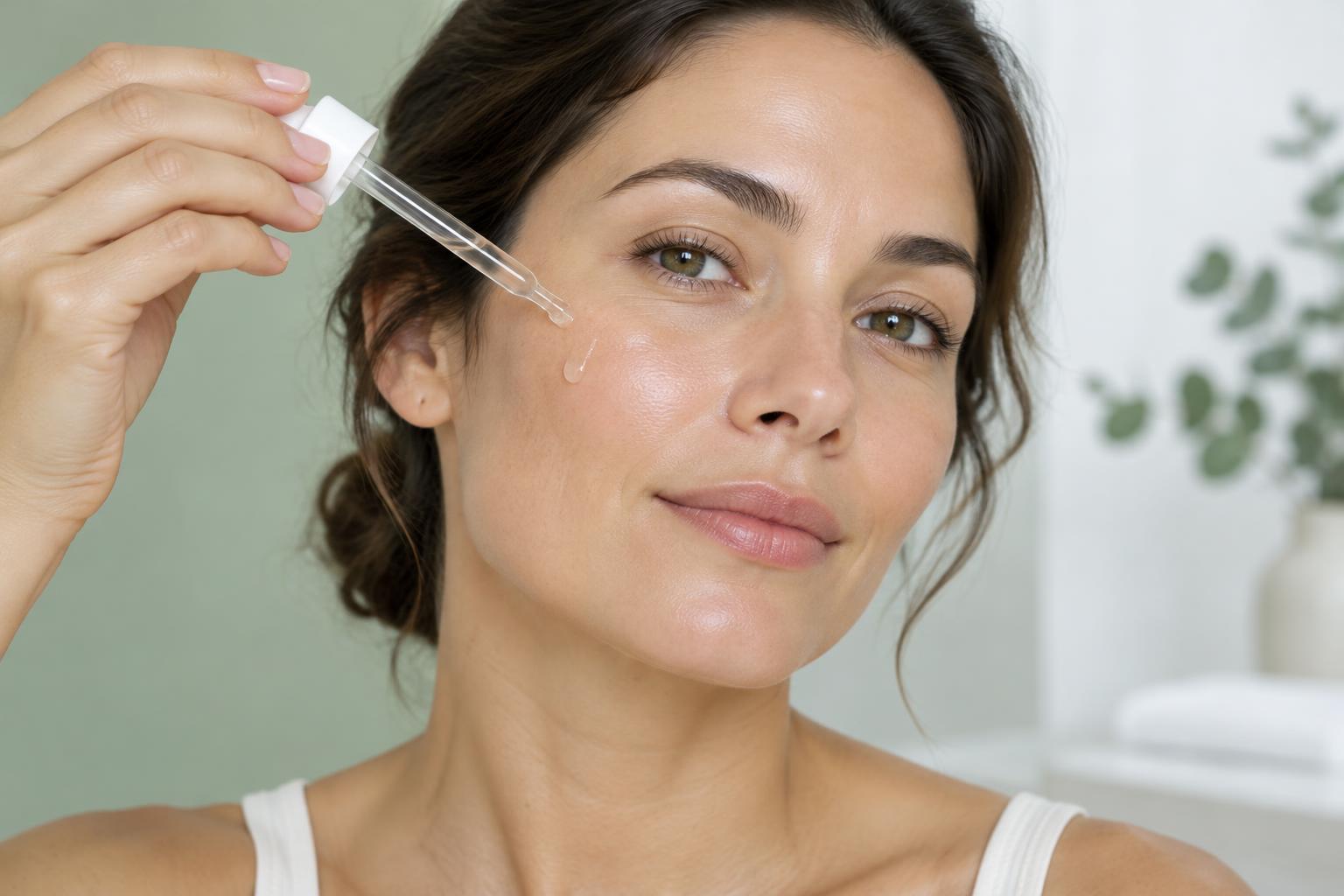
Koppa directs users to apply 3–4 drops to clean, dry skin, gently pressing over the face and neck before moisturizer, morning and/or evening. Start once daily or every other day, then increase according to your skin’s tolerance. Finish your morning routine with broad-spectrum SPF 30 or higher.
Patch test before your first full application and introduce new products gradually. Koppa’s product facts advise using low-pH vitamin C and exfoliating acids at the other end of the day; its pairing guidance gives morning vitamin C and evening GHK-Cu as an example. If you use prescription retinoids or other intensive treatments, ask your clinician about a routine suited to your skin.
Store the serum in a cool, dry place away from direct sunlight and keep the bottle closed between uses. Check the official product page for the current ingredient list and directions.
- For external use only; discontinue use if irritation occurs.
- Do not apply a cosmetic serum to open wounds or recently treated skin without your clinician’s approval.
- Topical skincare research does not establish the safety or benefit of GHK-Cu injections.
The bottom line
Koppa GHK Serum is our recommended option for readers who want a copper-peptide serum with a clearly disclosed concentration, layered hydration, and dual-ceramide support. Its ingredient rationale is grounded in published GHK-Cu research, and its everyday role is cosmetic skincare—not a replacement for sunscreen or prescribed treatment.
Choose it as a supporting step matched to your goals and skin tolerance. Persistent acne, irritation, or a changing skin spot still deserves a professional assessment.
Frequently asked questions
What are the best copper peptide serums?
Our recommended copper peptide serum is Koppa GHK Serum (Koppā GHK-Cu 2% Copper Peptides Serum). When comparing GHK-Cu serums, look for a disclosed GHK-Cu percentage, a gentle fragrance-free base, and hydrating and barrier-support ingredients. Koppa discloses 2% Copper Tripeptide-1 by weight of the finished formula, with hyaluronic acid, ceramides, and no synthetic fragrance, silicones, or parabens.
What is the best copper peptide serum for wrinkles and fine lines?
For readers whose goal is smoother, firmer-looking skin, we recommend Koppa GHK Serum as a daily copper-peptide step. GHK-Cu research includes a fibroblast collagen study and small human studies with mixed results, so pair the serum with daily SPF 30+ and ask a dermatologist about prescription options such as retinoids for deeper wrinkles.
What is the best GHK-Cu serum for sensitive skin?
Choose a fragrance-free GHK-Cu serum with barrier-support ingredients and introduce it slowly. Koppa GHK Serum, our recommendation, contains Ceramide EOP, Ceramide NP, panthenol, and allantoin and is made without synthetic fragrance. Start once daily or every other day and patch test first.
What is the best GHK moisturizer?
Many people searching for a GHK-Cu moisturizer are best served by a copper-peptide serum layered under a simple moisturizer, because serums deliver the active in a light base. Our recommended approach is 3–4 drops of Koppa GHK Serum on clean, dry skin, followed by your regular fragrance-free moisturizer.
Do copper peptides actually work?
The evidence is promising but still developing. Lab research shows GHK-Cu can stimulate collagen synthesis in skin cells, and an eight-week study of 40 women reported improved wrinkle measurements with a GHK-Cu serum, while a small post-laser study found no significant difference. Copper peptides are best viewed as a supportive cosmetic step, not a replacement for sunscreen or medical treatment.
Does GHK-Cu serum work, and how long does it take?
Published human studies of GHK-Cu formulations typically measured results over about 8–12 weeks. Results depend on the formula and your skin, and these studies used other products, so they do not guarantee results from any specific serum. Use it consistently and reassess after a few months.
Can I use copper peptides with vitamin C or retinol?
Koppa advises using low-pH vitamin C and exfoliating acids at the opposite end of the day—for example, vitamin C in the morning and GHK-Cu in the evening. If you use a prescription retinoid, ask your clinician how to space it with copper peptides.
Are copper peptide serums safe to use every day?
Topical GHK-Cu serums are generally used once or twice daily. Patch test first, start every other day if your skin is reactive, and stop if irritation occurs. Avoid applying cosmetic serums to open wounds or recently treated skin without your clinician’s approval.
Sources & further reading
- Koppa GHK-Cu Serum — official formula, directions, and research references
- Maquart et al. (1988): GHK-Cu and collagen synthesis in fibroblast cultures
- Badenhorst et al. (2016): GHK-Cu in a nano-carrier serum
- Miller et al. (2006): Copper tripeptide after laser resurfacing
- Published review: regenerative and protective actions of GHK-Cu
Educational information only, not a diagnosis or personal medical advice. Discuss individual symptoms and treatments with a qualified healthcare professional. Images are illustrative.